
The AI development landscape has shifted dramatically. A few years ago, typing a prompt into a conversational assistant like Claude AI and getting a block of React, HTML, or Python code felt like magic. You copy-pasted the snippet, set up your local environment, configured a database, wired up authentication, and pushed it to a server.
Today, platforms like Lovable take a natural-language description and deploy a full-stack, database-backed application with a live URL.
Does that mean Claude AI is obsolete for builders? Not quite. Understanding the difference between a reasoning engine and a full-stack builder changes how you ship software [cite: 1.1.3].
The Fundamental Difference: Thinking vs. Shipping
To answer the core question, you have to look at what you hold at the end of the session:
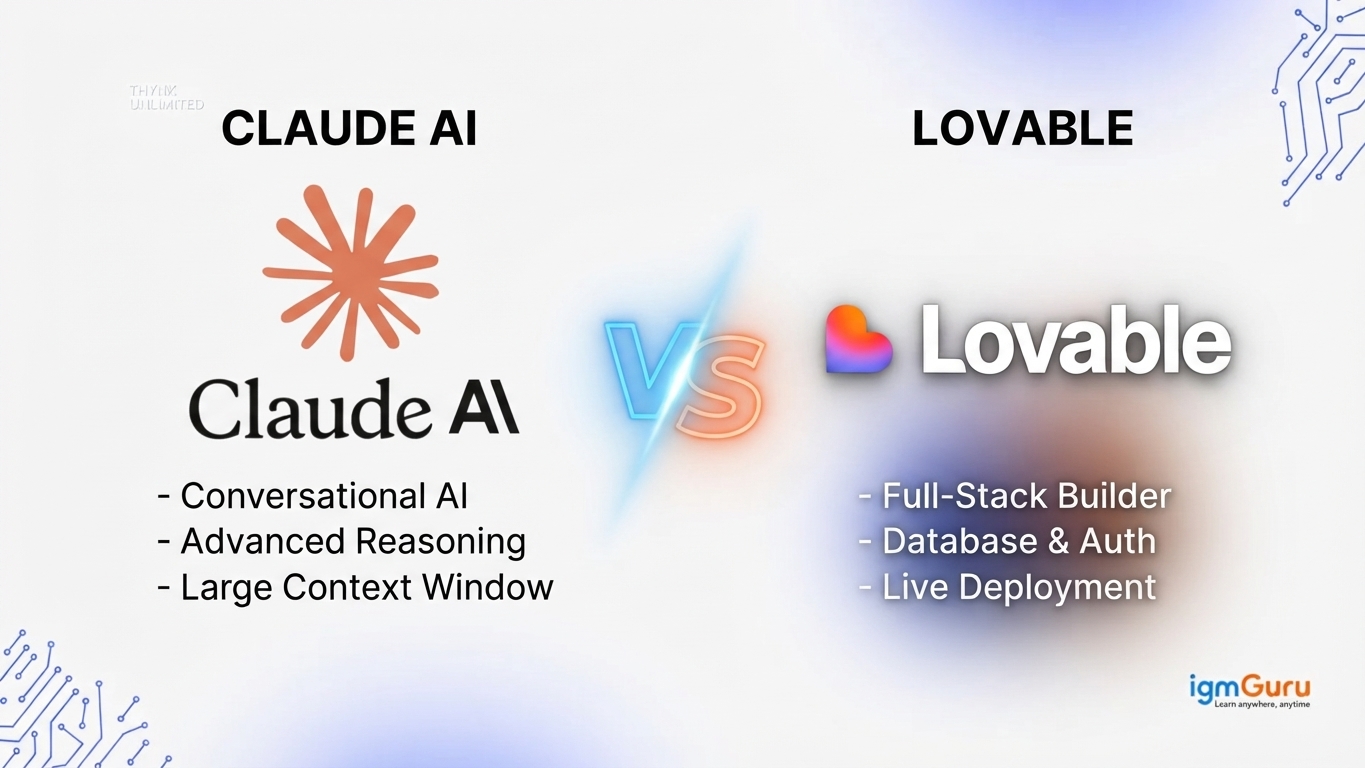
Claude AI (Chat/Artifacts): Gives you conversational logic, code explanations, isolated component previews, and raw code snippets. Infrastructure, hosting, database provisioning, and routing are 100% your problem [cite: 1.1.3].
Lovable: Operates as an autonomous full-stack app builder, spinning up React/TypeScript frontends, PostgreSQL databases via Lovable Cloud, authentication, storage, and live deployments from a single prompt [cite: 1.2.2].
If your goal is a working web app users can log into today, asking Lovable is objectively faster than assembling raw snippets from Claude AI.
Where Lovable Wins: Speed to Production
When building MVPs, internal dashboards, or functional prototypes, friction kills momentum. Lovable handles the heavy lifting that slows down early-stage execution:
Instant Infrastructure: No manual PostgreSQL setup, environment variable configuration, or Vercel pipeline plumbing.
Real-Time Visual Iteration: Watching Agent Mode refactor UI components and database schemas simultaneously beats manual copy-pasting.
Git Sync: Exporting or syncing clean TypeScript and React/TanStack code ensures you retain ownership without permanent vendor lock-in.
Why Claude AI Still Matters in the Stack
Lovable is actually powered by frontier models (often leveraging the same intelligence class), meaning they are teammates rather than enemies. You use Claude AI when you need:
Complex Architecture Logic: Thinking through edge cases in multi-tenant data schemas, financial ledger math, or algorithmic constraints before touching a builder.
Deep Code Review: Analyzing logic flows, debugging obscure TypeScript typing errors, or writing unit test suites.
Custom Codebases: Working inside a massive existing monorepo where a visual cloud builder lacks deep file-tree context.
The Smart Workflow: Combine Both
The false dichotomy is choosing one. High-output founders and lean product teams use a hybrid approach:
Plan with Claude AI: Map out user journeys, data models, and API boundaries through conversational reasoning.
Build with Lovable: Prompt the full-stack architecture, seed your database tables, and get a live staging link in minutes.
Refine and Extend: Sync to GitHub and polish production code where fine-grained control takes over.
Verdict
Use Claude AI when you need to think, design logic, or debug. Use Lovable when you need to ship a live product with a database and auth right now [cite: 1.1.3].
Drop a comment below: are you shipping MVPs with visual AI builders yet, or do you still prefer starting from a blank code editor?
Wilt u Europese klanten, niet alleen verkeer?
Boek een gratis gesprek en we brengen uw product, uw ideale Europese koper en de snelste route naar eerste orders in kaart.
Plan een gesprek